Renewable Energy Structures: Transfer Credits

Nov 17, 2026
What Are Transfer Credits and How Do They Work?

The Inflation Reduction Act (IRA) of 2022 introduced a new opportunity for investors to participate in clean energy tax incentives. Instead of entering into complex tax equity partnerships, investors can now access the ITC through direct purchases, creating a more straightforward path to deploy capital into renewable energy projects.Β Β 

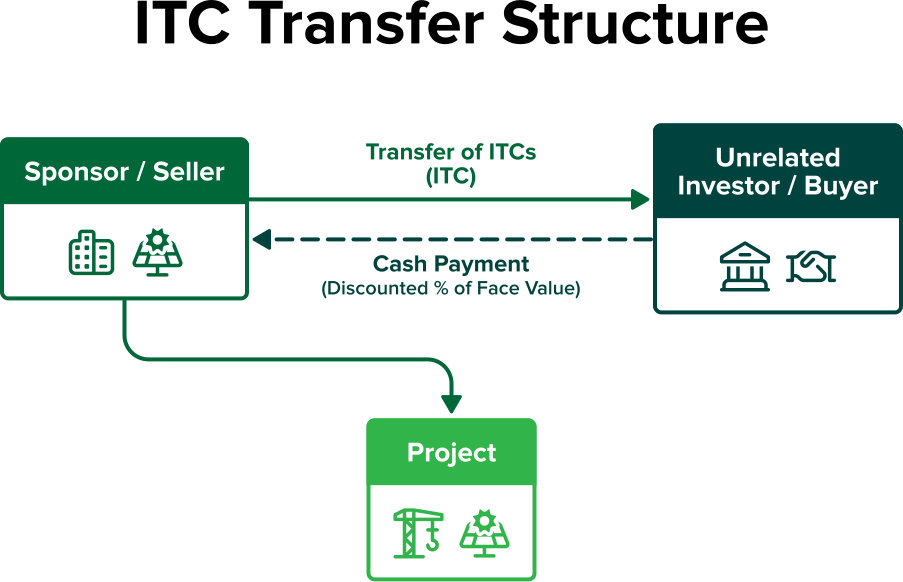
Under the Transfer Credit structure, ITCs generated by a project can be sold by the Sponsor to an unrelated investor. Investors do not take an equity position in the asset and are not allocated operating losses, cash flow, or residual value at exit. The transaction is structured as a direct purchase of the credits, allowing investors to offset federal tax liability while sponsors receive upfront liquidity. Since the structure was introduced, investor demand has grown rapidly, with the transferable credit market estimated at approximately $42 billion in 2025.Β 

What are the Benefits of this Structure?

A Transfer Credit deal structure is attractive because it is treated as a simple cash transaction for accounting purposes. When an investor purchases a transferable tax credit, it is treated as a payment of taxes owed rather than a reduction in taxes owed, so no asset is created on the balance sheet. This avoids the impairment issues that arise in some traditional tax equity partnerships, where investors must recognize losses under GAAP due to ongoing allocations of depreciable losses or cash.

  • Ease of Accounting β€” By eliminating impairments and removing the need to track long‑term partnership allocations, accounting becomes far more straightforward. This simplicity lowers barriers to entry and encourages participation from investors who might otherwise avoid complex tax equity structures. Investors can also pair tax credit purchases with Renewable Energy Certificates through separate contracts, further enhancing the sustainability impact of their investment.
  • Ease of Execution β€” The IRS has issued clear guidelines and created an online registration portal to support the transfer process, making it accessible even for investors without specialized tax equity expertise. Because the structure functions as a direct transfer rather than a multilayered partnership, new investors can participate without navigating the complexities typically associated with traditional tax equity deals. This streamlined approach broadens the investor base and supports greater investment flow into eligible projects.
What are the Challenges of this Structure?
  • Even though Transfer Credit Structures are simpler than some other structures, they still involve detailed financial, technical, and legal requirements that can be challenging for newer buyers and sellers to the market to navigate on their own.
  • Each project must be carefully reviewed to confirm it meets all tax credit eligibility standards, pricing must be negotiated to ensure fair value for both sides, and term sheets and transfer agreements must be drafted to clearly define key terms such as price, payment timing, and contingencies.
  • The IRS pre‑registration process also requires accurate documentation, and after the sale, projects remain subject to a five‑year recapture period during which the IRS can reclaim credits if certain conditions are not met.
  • For experienced solar investors in the market, returns from Transfer-structure deals are lower than those from P-Flips. You will need to do more transfer deals to get the same tax savings as P-Flips.
  • As a newer investment opportunity to the market, Transfer credit opportunities have brought many newcomers to the renewable energy investment space, from both a Sponsor and an Investor’s side. These newcomers may not have the experience to understand the risks, structures, and opportunities that best fit their partners' needs and goals.
We’re Here to Help

National Trust Energy Capital helps streamline every stage of this process by managing document reviews, negotiating pricing, preparing transaction documents, guiding participants through registration, and, when needed, providing asset management throughout the recapture period. This support reduces risk, saves time, and makes the transfer credit experience significantly easier for all parties involved.Β 

Interested in learning more? Want to work with us? Reach out to our Director of National Trust Energy Capital, Paul Holshouser, at pholshouser@ntcic.com, or contact us using the form below.

Invest With Us

Since our inception in 2012, National Trust Energy Capital has helped investors navigate renewable energy investments to reach their impact and financial goals. We work to pair investors with the right renewable energy projects that will bring cost-effective energy options and growth to low-income communities, improve tax efficiency, and create a greener future.

Ready to Inspire a Sustainable Future?


By submitting this form, you are consenting to receive marketing emails from: . You can revoke your consent to receive emails at any time by using the SafeUnsubscribe® link, found at the bottom of every email. Emails are serviced by Constant Contact