

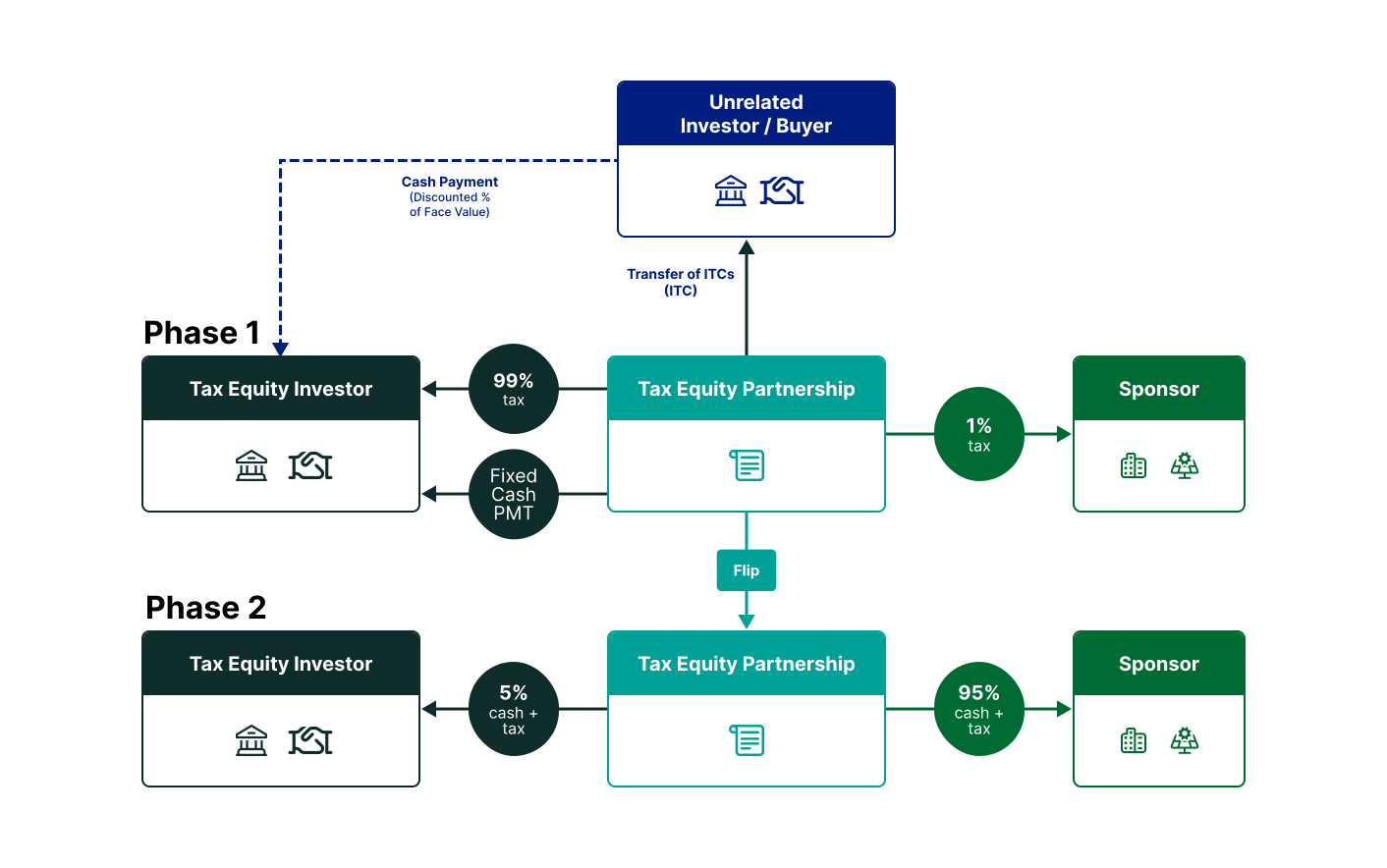
The creation of credit transfers in the Inflation Reduction Act of 2022 also created Hybrid Partnership transactions, where an investment Partnership is created to facilitate project investment, and some or all tax credits are transferred out of the Partnership to a credit buyer. From an organizational chart perspective, this simply adds the credit transfer to the existing Partnership Flip investment, while the largest tax attribute, the tax credit, moves to the credit buyer.
Within the Hybrid transaction category, there are two primary variations that reflect the goals of the Investor. Common labels for these variations are T-Flips and Preferred Equity investments. A T-Flip structure is the preferred choice for Investors who can use tax deductions from project Depreciation. A Preferred Equity structure is designed for Investors without significant tax liabilities to offset Depreciation deductions.
T-Flip deals very closely mirror the Partnership Flip. Investment amounts are often quoted based on an equity value per dollar of tax credit for ITC deals, usually slightly over $1.00 per credit. During Phase I, there is a fixed cash distribution of 1-3% of Invested Capital and a 99% tax allocation to the Investor. Like a standard Partnership Flip, the structure “flips” to Phase II based on a fixed amount of time or the Investor achieving a return hurdle. The duration of Phase I for a T-Flip is generally the same as a Partnership Flip – roughly 6 years. Investors will have a Buyout Option to exit the partnership for a period after the Flip Date.
The distinction between Partnership Flips and T-Flips is the credit transfer. The Investor may choose to sell all or a portion of the credit based on their tax position. The tax credit transfer proceeds will usually be fully distributed to the Investor.
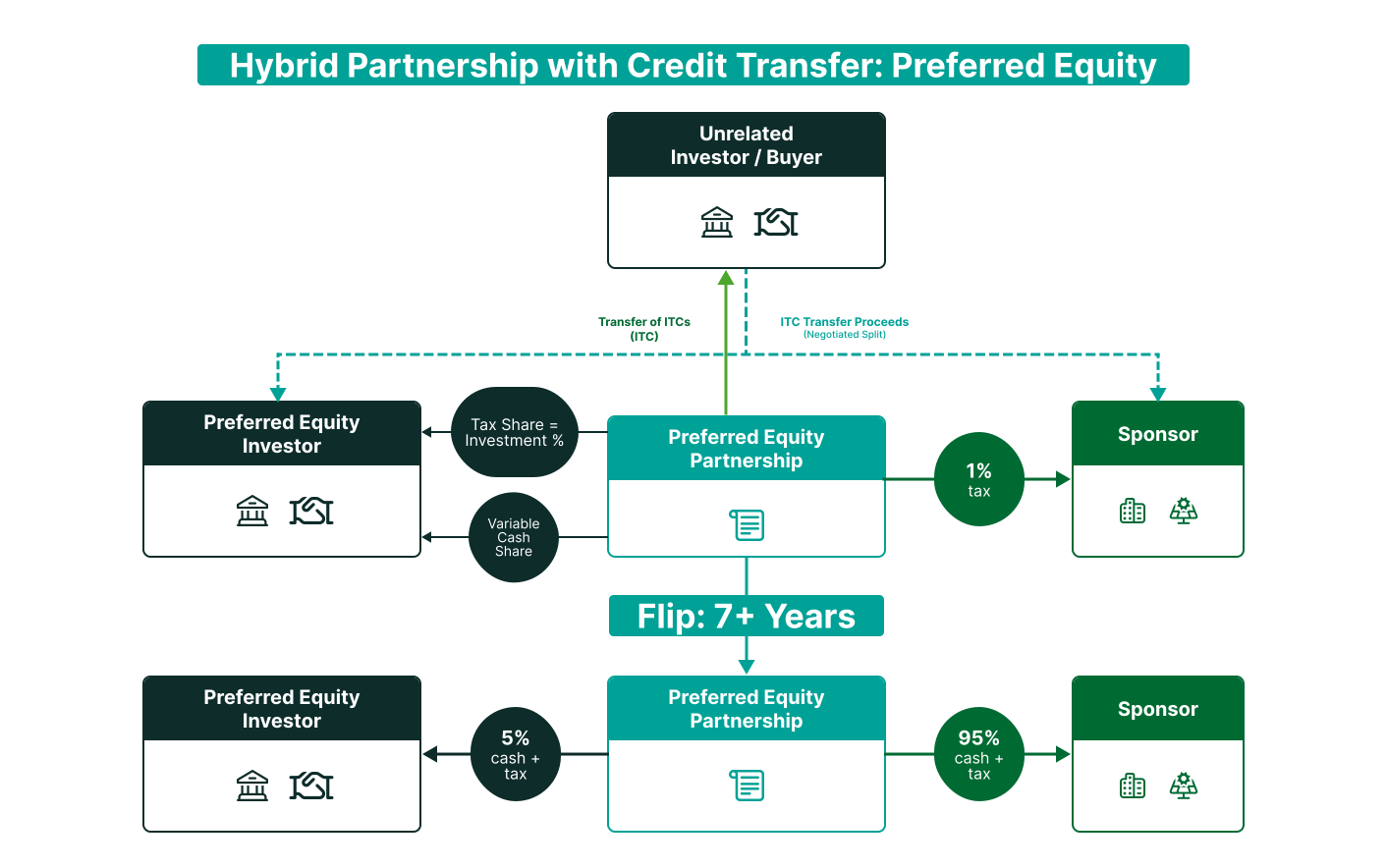
The Preferred Equity structure iterates further on the Partnership foundation with more variation and more flexibility. These Investors generally do not have significant tax liabilities to offset with Project Depreciation, which has created meaningful differentiation from the original structure.
What aspects of Preferred Equity and T-Flips are the same?
What aspects are different in Preferred Equity deals?
T-Flips and Preferred Equity Structures offer new deal options and expanded appeal to Investors, but each variation on the structure adds complexity to the deal. Financial, technical, and legal diligence must be sound, tax credit values must be properly validated, and every participant in the deal needs to be matched in a way that aligns incentives and minimizes friction.
National Trust Energy Capital has the knowledge and network to eliminate those pain points. Our longstanding advisory relationships ensure that tax credits are properly established and valued, while top-tier accounting partners and a deep legal bench provide high-quality due diligence and mitigation of deal concerns. Because we prioritize repeat business, we structure terms that are fair, market-aligned, and designed so no party feels disadvantaged. Our experience matching projects with the right investors and credit buyers, combined with a strong record of trusted partnerships, creates a smoother, more predictable process. With well–prepared documentation and a vast knowledge network, National Trust Energy Capital can turn a complex deal structure into a reliable, repeatable investment experience
Interested in learning more? Want to work with us? Reach out to our Director of National Trust Energy Capital, Paul Holshouser, at pholshouser@ntcic.com, or contact us using the form below.
Since our inception in 2012, National Trust Energy Capital has helped investors navigate renewable energy investments to reach their impact and financial goals. We work to pair investors with the right renewable energy projects that will bring cost-effective energy options and growth to low-income communities, improve tax efficiency, and create a greener future.